Android alpha · closed testing
Record the work. Understand the change.
Three things, on the phone in your hand. Keep the history of every part, repair and modification. Read what your vehicle reports. Put the readings before the work next to the readings after it.
Requires Android 10 or newer. Closed testing is open in the United States only. Vehicle readings need an ELM327-compatible Bluetooth OBD-II adapter.

What it does
Build history, vehicle readings, and the comparison between them.
Everything below is in the closed-test build today. What is designed and not built has a section of its own further down, so the two are never mixed.

What it reads
Ten signals, in four groups.
These are the readings the closed-test build shows. Your vehicle is asked which of them it supports, and only those are polled, so the set you see is the set your vehicle answers to.
Coolant temperature is read today. Transmission and oil temperature are outside the standard set and are not yet proven on any vehicle.
Trouble codes
Torkmark reads stored, pending and permanent trouble codes and decodes them to plain English. In the current build they appear in the diagnostics log rather than on their own screen.
Module-level reads are planned and are not in the closed-test build.
Your limits, not ours
Set your own limits for each reading; Torkmark shows the number against the limit you set. There is no universal healthy number published here, because a number that is normal on one engine is not on the next.
When there is no number
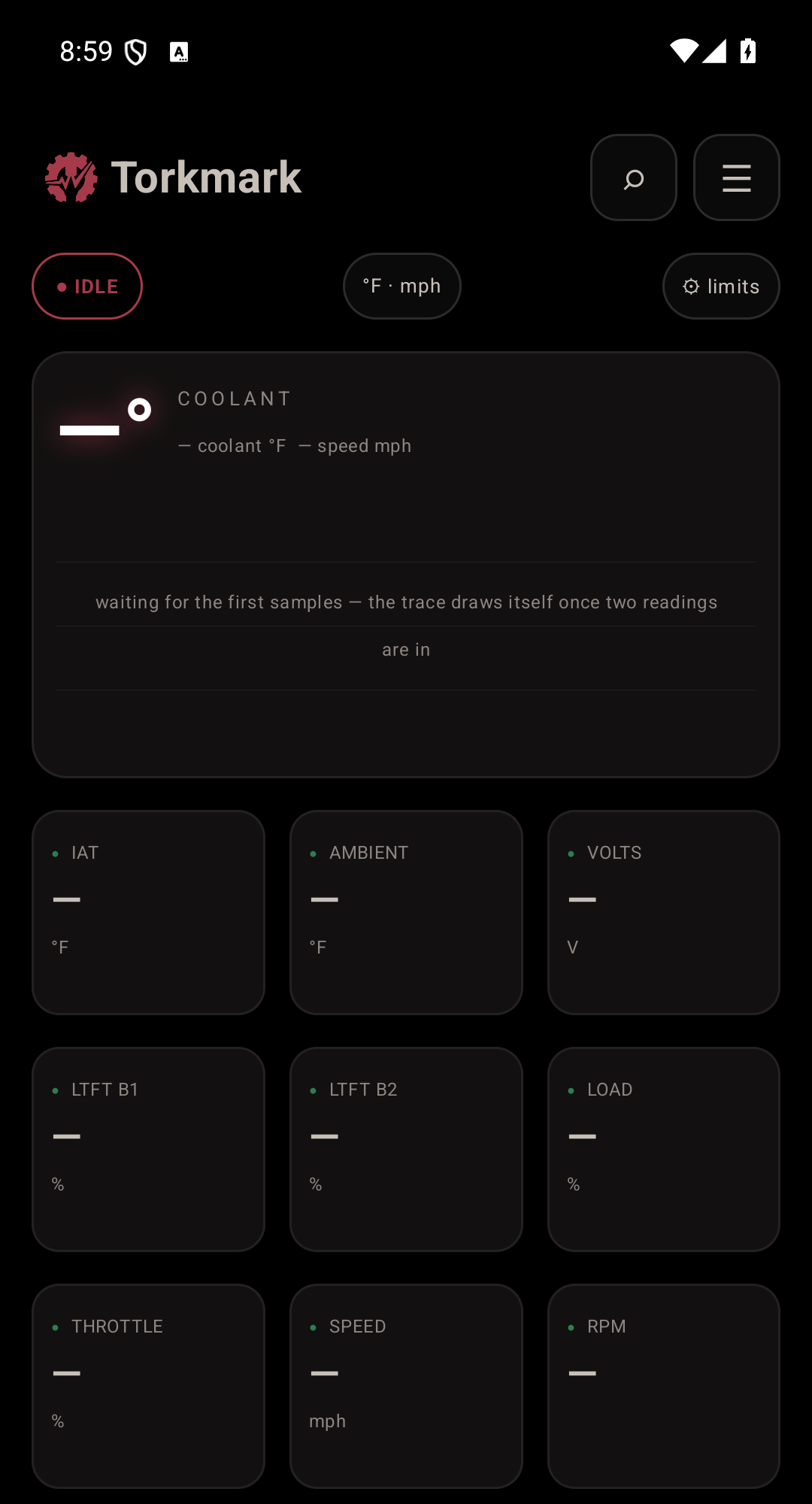
A missing reading is never drawn as zero.
Anything Torkmark cannot read is shown as a dash, never as a number. Five different things can put that dash there, and they mean different things to you.
- No data recordedNothing has been read for this signal yet.
- Adapter disconnectedThe adapter is not connected, so nothing can be read right now.
- Signal unavailableThe vehicle did not answer for this signal during negotiation.
- Vehicle support unverifiedNobody has proven this reading on this vehicle yet.
- Feature not yet releasedThe reading is designed and not in the closed-test build.
The app itself
What it actually looks like.
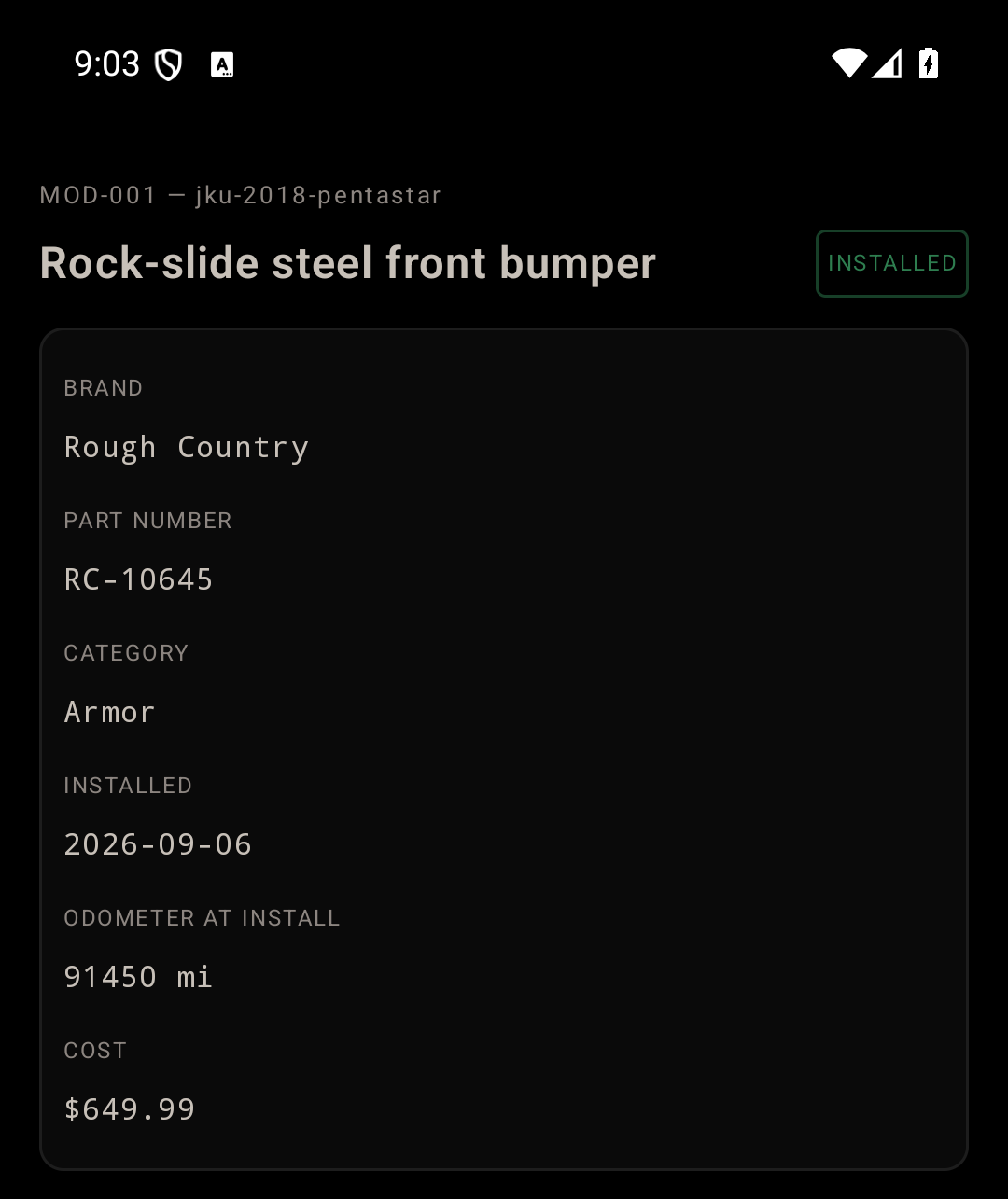
Two screenshots of the current build, cropped to the part that matters, and one panel drawn on this page to show the shape of a comparison. The panel is a drawing, not a screen.
Illustrative example — sample data
Before
214 °F
Peak coolant, most recent drive before the work
The work
Fan clutch replaced
2 April 2026 · 79,404 miles
After
203 °F
Peak coolant, most recent drive after the work
Where it lives
On your phone, and what that costs you.
Your recorded readings upload to your account; your build history, drive summaries, trouble codes and settings stay on your phone.
No ads, no third-party analytics, and your data is not sold. The privacy policy sets out what is held, where, and for how long.
Designed, not built
What is not here yet.
Named so you can weigh it, not sold. Nothing in this section is in the closed-test build, and none of it has a date.
Early access
Request early access.
Email the Google account you use with Google Play. That address goes on the tester list and the reply carries the Play opt-in link. Signing in does not enrol you.
The full detail — who can join, what you need, what it costs today — is on the home page access section.